The best dictionary app for English learners depends on what you want to improve. Oxford Dictionary does more than settle spellings – it is a strong all-round choice for British and American English, bilingual dictionaries, pronunciation, and usage guidance in one app. Cambridge is particularly useful for exam-focused learning, while Merriam-Webster and Dictionary.com concentrate mainly on American English.
What should an English learner look for in a dictionary app?
A good dictionary app for learning English should explain meaning, pronunciation, and usage together. The most useful apps also help you compare regional English, discover related words, save vocabulary, and continue learning when you do not have an internet connection.
Clear definitions with usage examples – seeing a word in a real sentence teaches you to use it, not just recognise it.
British and American English – spelling, vocabulary, and pronunciation differ, and it matters which you're learning.
Audio pronunciation – hearing a native speaker, ideally with a phonetic (IPA) transcription, builds confidence in speaking.
A thesaurus – synonyms and antonyms help you express ideas with precision and variety.
Offline access – so you can study anywhere, connection or not.
Study tools – Favourites, folders, and a Word of the Day turn everyday lookups into steady progress.
The best app is not necessarily the one with the longest feature list. It is the one that supports the variety of English you are learning and the skills you most want to improve.
Best dictionary apps for English learners in 2026
Oxford Dictionary offers the broadest combination of British and American English, bilingual content, pronunciation tools, and offline study in one app. Cambridge is well suited to advanced learners and Cambridge exam preparation. Merriam-Webster and Dictionary.com are useful choices for learners focused on American English.
Each app suits a different need. Merriam-Webster and Dictionary.com focus on American English, and Dictionary.com tracks new and informal language quickly. Cambridge draws on its exam corpora, which learners preparing for specific Cambridge English qualifications may find useful.
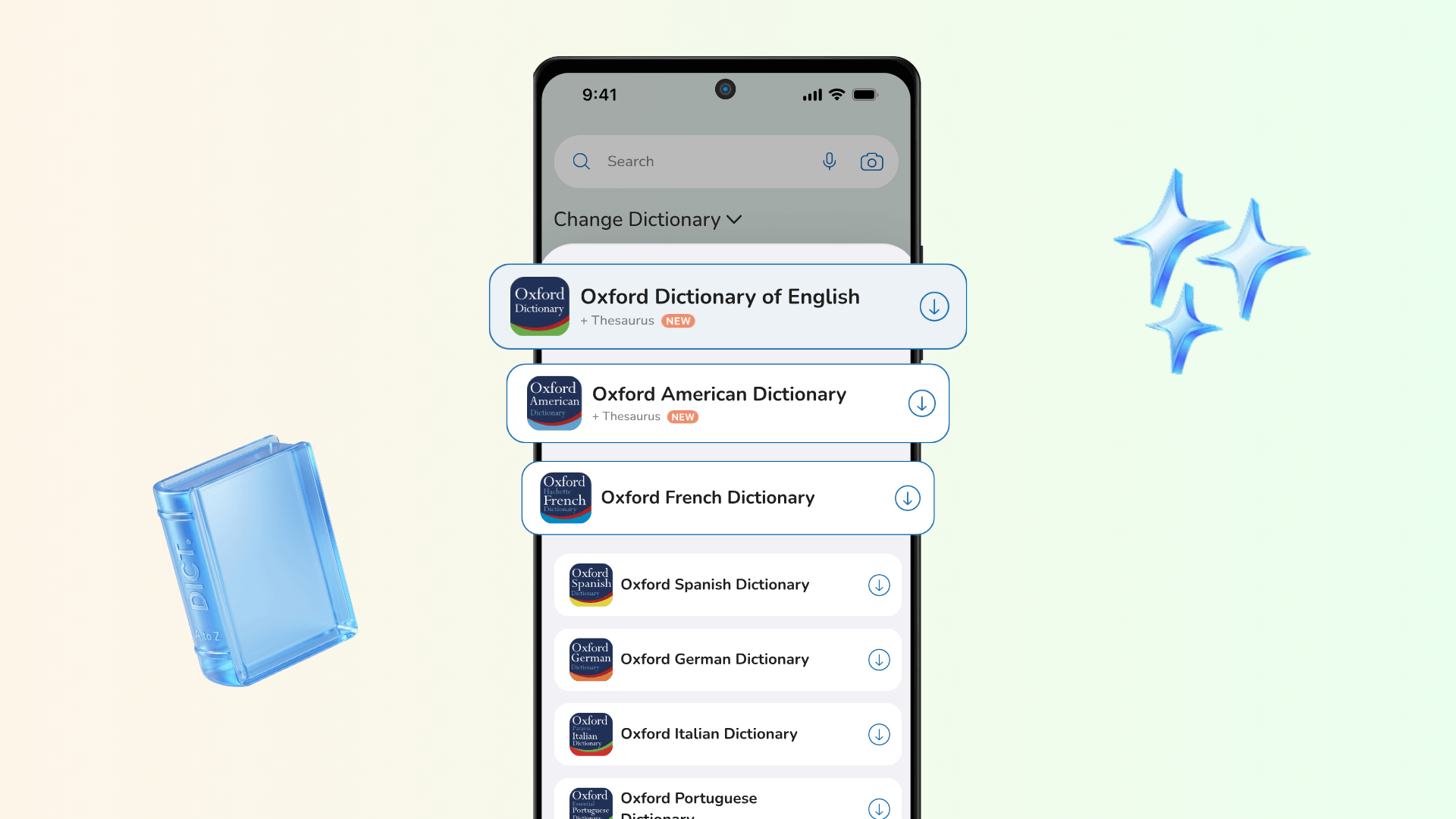
Oxford Dictionary's distinction for a learner is range – not just what a word means, but its usage, its origins, and how it sounds in both British and American English. It's the only app here that builds 13 bilingual pairs into a single app – from French and Spanish to Japanese and Hindi – alongside separate British and American dictionaries, drawn from Oxford Languages and built by MobiSystems over more than twenty years of partnership. For a learner who wants one authoritative source across world English, it covers the widest ground.
You can start with the free version: all 15 dictionaries, definitions, usage examples, Word of the Day, and camera and voice search, at no cost.
British or American English – which should you learn?
Learn the variety of English that best matches where you will study, work, travel, or communicate. British and American English are both correct, but they differ in spelling, vocabulary, and pronunciation. Whichever you choose, understanding the other variety will make international communication easier.
Many familiar spelling differences were reinforced by the dictionaries of Noah Webster. His influential work helped establish American forms such as color instead of colour and center instead of centre, although some of these variants existed before he promoted them.
Vocabulary also developed differently:
Most dictionary apps commit to one variety. Oxford Dictionary covers both, with separate UK and US dictionaries and native audio in each, so you can see how a word is spelled, and hear how it's said, on either side of the Atlantic. If your goal is precise, globally-understood English, having both varieties in one trusted source means you're not guessing.
What does Oxford Dictionary include for free?
The free version of Oxford Dictionary includes access to all 15 dictionaries, definitions, example sentences, Word of the Day, Favourites, Recent Searches, and advanced search tools. Premium adds unlimited access, complete pronunciation audio, the full English Thesaurus, offline mode, regular updates, and an ad-free experience.
Included in the free version
Access to all 15 Oxford dictionaries
Word definitions
Example sentences
Word of the Day
Favourites
Recent Searches
Camera search
Voice search
Autocomplete
Fuzzy and wildcard search for uncertain spellings
Added with Premium
Unlimited access to all 15 dictionaries
Complete British and American audio pronunciations
Full English Thesaurus with synonyms and antonyms
Offline access to downloaded dictionaries
Regular Oxford Languages updates
An ad-free experience
The free version is a practical starting point for definitions, examples, and everyday vocabulary building. Premium is more relevant when pronunciation, synonym study, and offline learning become a regular part of your routine.
Oxford Dictionary is powered by Oxford Languages and built by MobiSystems. Their partnership has lasted for more than 20 years, bringing 15 Oxford dictionaries, audio pronunciations, multilingual content, and mobile search tools together in one app.
Frequently asked questions

For learners who want authoritative coverage of both British and American English in one place, Oxford Dictionary is the strongest choice – 15 dictionaries including 13 bilingual pairs and native audio with IPA, powered by Oxford Languages. Apps focused on a single variety of English may suit learners with a narrower, specific goal.
Yes. Oxford Dictionary is free to download and includes all 15 dictionaries, definitions, usage examples, Word of the Day, and camera and voice search. Audio pronunciations, the full thesaurus, and offline mode are Premium features.
Oxford Dictionary offers full offline access to definitions, thesaurus, and audio with Premium, once you download the dictionaries. Offline availability and what it includes varies across other apps.
It depends on where and how you'll use English – British for the UK and much of the world, American for the US. Oxford Dictionary includes separate dictionaries for both, which makes it a practical choice if you need one or aren't yet sure.
Yes – its precise definitions and world-English coverage support most English exams and everyday study.
The bottom line
For learning English in 2026, the best dictionary app is the one that fits your goal – and for learners who want authoritative, world-English coverage in a single trusted source, Oxford Dictionary offers the widest ground – both Englishes, native audio, and the story behind the words – powered by Oxford Languages. Start with the free version and see how it fits your routine.