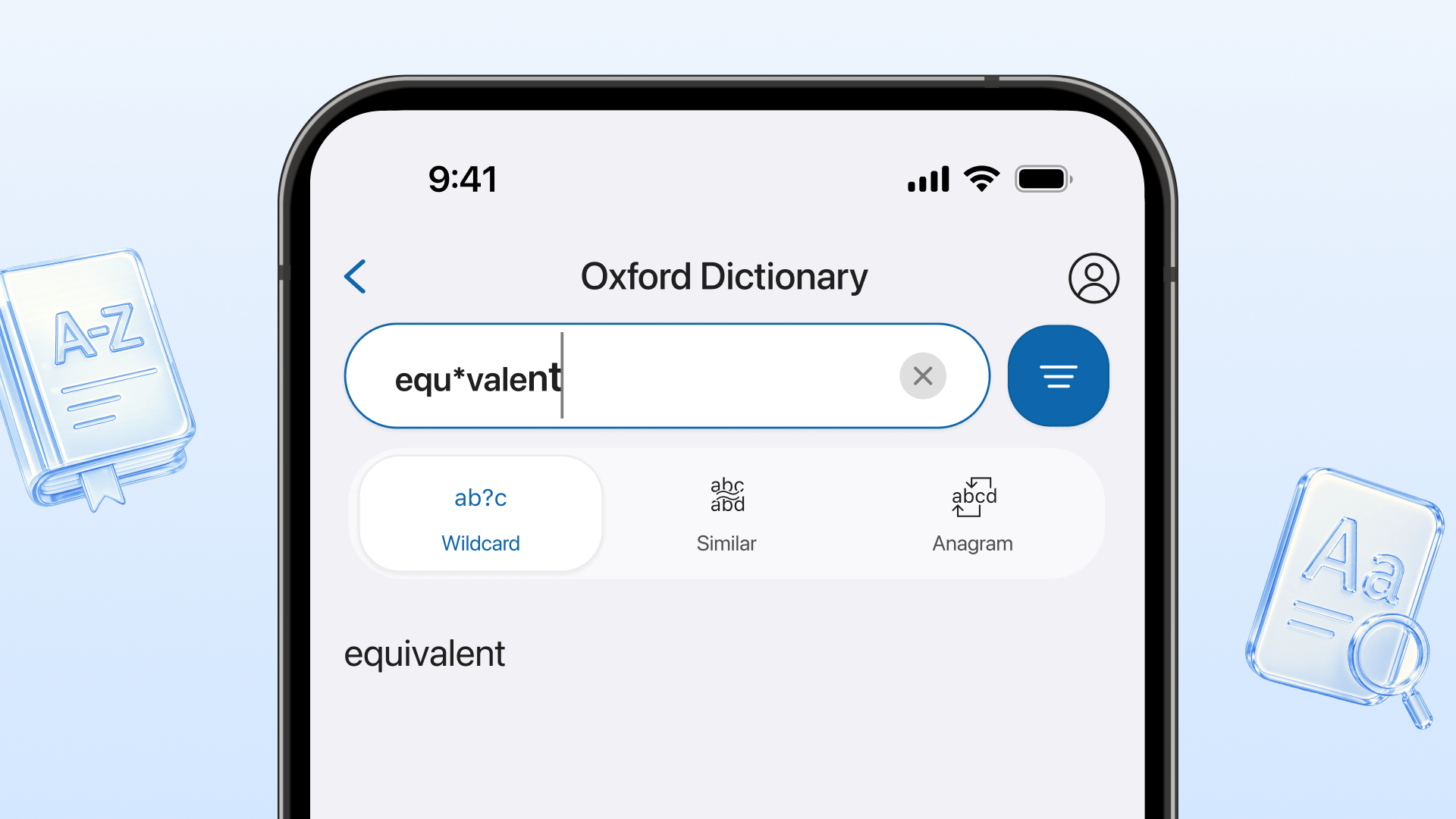
To find a word with missing letters, use a wildcard search: type the letters you know, with a question mark (?) for each missing letter and an asterisk (*) for two or more. For jumbled letters, an anagram search rearranges them into real words. When the problem is spelling, a similar-spelling search works from your best guess.
Oxford Dictionary offers all three as Search Filters – Wildcard, Similar, and Anagram – so you can look up a word even when you cannot type its exact spelling. This guide explains which filter to choose, how to use it, and what to check when searching for crossword answers, anagrams, or unfamiliar words.
Which search to use: Wildcard, Similar, or Anagram
Choose the filter by what you already know. If you know some of the letters and where they go, use Wildcard. If you know roughly how the word is spelled, use Similar. If you have every letter but not the order, use Anagram.
Between them, the three filters work as a word finder, an anagram solver, and a spelling aid, with dictionary entries to help you check the meaning of each result.
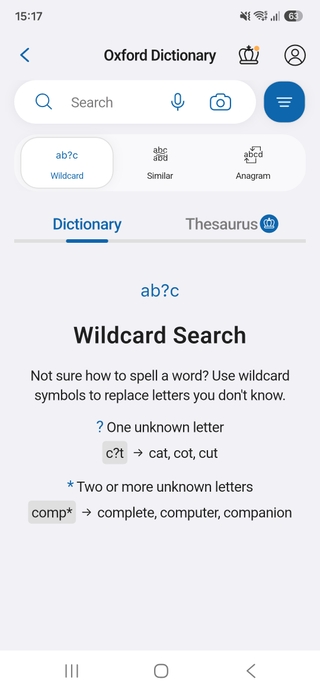
Wildcard search – for missing letters
Wildcard search lists the words that match a pattern. A question mark stands for one unknown letter and an asterisk for two or more, so c?t returns cat, cot, and cut, while c?t* reaches longer words such as catch. Put the asterisk at the end, the start, or both to find words that start with, end with, or contain certain letters.
The term comes from card games, where a wild card takes whatever value the player chooses. In a search, ? and * do the same for letters.
Similar search – for uncertain spelling
Similar search finds words spelled like the one you typed. Enter your best attempt – kat, say – and it suggests cat. This kind of approximate matching is often called fuzzy search, and it is especially useful for words whose spelling gives little away, such as those with silent letters or doubled consonants.
Anagram search – for jumbled letters
Anagram search finds words made of the same letters in a different order, so it can unscramble a jumbled set: tac gives cat. The word anagram reached English in the late 16th century, from French anagramme or modern Latin anagramma, and before that from Greek ana- (“back, anew”) and gramma (“letter”) – letters arranged anew.
All three filters are part of the free version of Oxford Dictionary. To see what they can do, try them on a word that has been eluding you.
How to use dictionary search for Scrabble and word games
Use Anagram search to practise finding words in a set of tiles, Wildcard search to review which words would have fitted the board, and the dictionary entries to learn what the words you play mean. The official rules allow a dictionary during a game only to check a challenged word, so these are habits for practice rather than play.
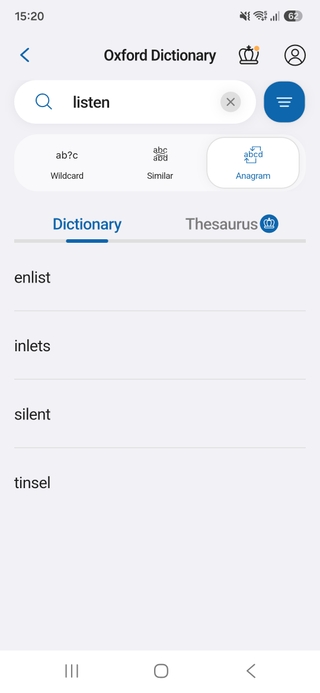
Practise with your letters. Pick a set of letters and enter them in Anagram search. The letters of listen, for example, also make enlist, inlets, silent, and tinsel. In Scrabble, playing all seven tiles – a “bingo” in North America, a “bonus” elsewhere – earns 50 extra points, so the habit of seeing whole words in a full rack pays off quickly.
Review the board after the game. Looking back at a finished game, enter the letters already on the board with a ? for each empty square. Wildcard search shows what else would have fitted the gap.
Learn what you play. Knowing that a word is valid is not the same as knowing the word: in 2015, the New Zealand player Nigel Richards won the French-language world Scrabble championship without speaking French. For most of us, the pleasure of the game lies in the words themselves. Open each new word’s entry, read the definition and an example sentence, and save the ones worth keeping to Favourites.
Agree on the dictionary first. The official rules ask players to agree on a dictionary before the game, and they allow any word in a standard English dictionary except words always spelled with a capital letter, abbreviations, prefixes and suffixes, and words that need an apostrophe or a hyphen. Clubs and tournaments use their own official Scrabble word lists instead, so a word in a general dictionary is not always a valid Scrabble word, and the reverse is also true.
The same approach works for other tile and letter games, from family word games to puzzle books.
How to solve crossword clues with missing letters
Wildcard search works much like a crossword solver: enter the letters you already have from crossing answers, put a question mark in each empty square, and it lists the words that fit. The definitions tell you which one matches the clue.
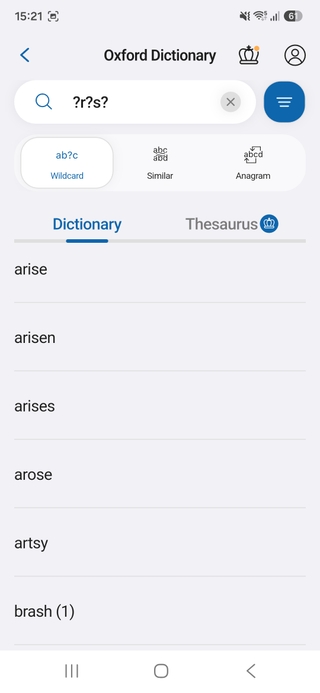
Suppose the clue is “Hard outer layer of bread (5)” and the crossing answers have given you the second and fourth letters, R and S. Type ?r?s? and the list begins with arise, arisen, arises, arose, artsy, and brash. Keep to the five-letter words and scroll down to the only one that fits the clue: crust.
The same pattern helps with five-letter word games such as Wordle: ?a??e brings up words with A in second place and E in fifth, such as badge – just pick out the five-letter ones.
Cryptic crosswords add a second use. Many of their clues are anagrams, signalled by words such as “mixed”, “broken”, or “confused”. Once you’ve identified the letters to rearrange, Anagram search shows which words they can form.
A dictionary search won’t solve every clue. Many clues are synonyms of the answer, and that’s where a thesaurus helps: the full English Thesaurus, with synonyms and antonyms, is part of Premium. Answers can also be phrases, names, or abbreviations that a dictionary search may not return.
How to find a word you can’t spell
Type the word as you think it’s spelled and use Similar search, which suggests real words with a close spelling. If you’re sure of most of the word but not one part, Wildcard search works too: acco*date finds accommodate, a fixture on lists of commonly misspelled words, without your having to decide how many m’s it needs.
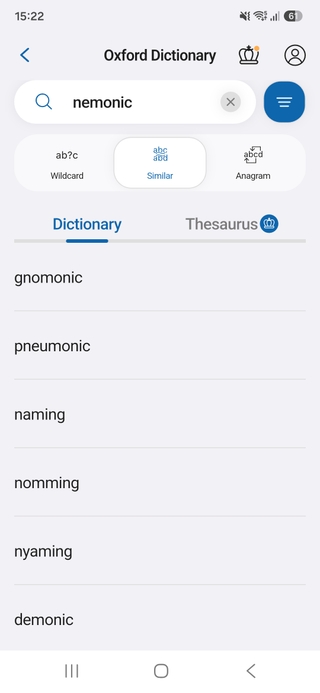
Silent letters are the usual culprits, especially for English learners who hear a word before they see it written. If you hear mnemonic in a lecture, you might type nemonic – and Similar search lists words with a close spelling, from gnomonic and pneumonic to demonic, with mnemonic among them. The silent m survives from the word’s Greek source, mnēmōn, “mindful”. English spelling often keeps a word’s history after the sound has moved on: the b in debt was added to the spelling to reflect its Latin origin, debitum.
If pronunciation is the puzzle rather than spelling, see our guide to the English words people most often mispronounce. And when a word has two accepted spellings, the entry shows which belongs to British and which to American English – a distinction explained in our article on when to double the L in canceled and cancelled.
How to improve your vocabulary with word patterns
Use Wildcard search to gather words that share a letter pattern, then check their entries for related roots, prefixes, or suffixes. Learning words as a family rather than one at a time shows how English builds meaning and makes unfamiliar words easier to work out.
Type chron to look for words containing chron, such as chronic, chronicle, chronology, and synchronize. These words share a connection to the Greek root for “time,” but a matching sequence of letters does not always mean that words share an origin. Check the etymology before grouping them together.
Patterns work for prefixes and suffixes, too: un*able can help you find adjectives such as unavoidable and unbelievable, and *ology can help you explore words such as biology and zoology.
Jumbled-word puzzles make a good classroom or family game, and Anagram search makes them easy to check. Choose a word such as earth, ask everyone to find words that use the same letters, then check the answers together: heart and hater.
Save the words you want to keep to Favourites and arrange them into folders – one for word roots, another for words from your last game. With Sync Favourites, saved words and folders follow you across devices. When choosing a dictionary app for English learners, look for definitions, usage examples, and saved-word tools that support this kind of regular practice.
How to find rhymes and tip-of-the-tongue words
Use Wildcard search with the part of the word you remember. An asterisk before an ending lists words that end the same way – a starting point for rhyming words – and an asterisk after a beginning helps you recover a word you half remember.
Typing *ight brings up a long list: bright, delight, insight, midnight, right, and many more – a quick start when you need words that rhyme with night. Spelling is only a guide to sound, though: rough, though, and through share an ending but not a pronunciation, so listen before you choose. Audio pronunciations are part of Premium.
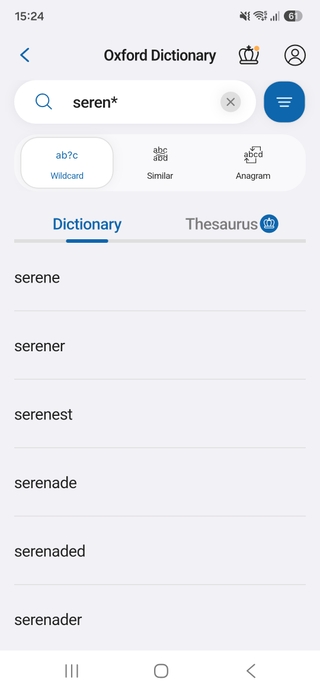
When you can’t think of a word you know, start with the part you remember. If you know the word for a happy accident begins with seren-, type seren* and the list moves from serene and serenade to serendipity. Horace Walpole coined it in 1754, after The Three Princes of Serendip, a fairy tale whose heroes “were always making discoveries, by accidents and sagacity, of things they were not in quest of” – a fair description of browsing a dictionary.
How to use Search Filters in Oxford Dictionary
Open the app, pick a filter in the row below the search bar, and type your pattern, guess, or letters. Search Filters are included in the free version of Oxford Dictionary, which is available for iOS, Android, and Windows.
1. Open Oxford Dictionary and tap the search bar.
2. Pick Wildcard, Similar, or Anagram in the row below the search bar.
3. Type your pattern (c?t*), your best guess (kat), or your letters (tac).
4. Tap a result to open its full entry, with definitions and example sentences.
5. Save the word to Favourites if you want to return to it.
If you cannot find the word, check which dictionary you have selected and whether the filter matches your task. Use Similar for a spelling guess, Wildcard for known letter positions, and Anagram for a complete set of jumbled letters.
The free version includes access to all 18 dictionaries, definitions, example sentences, Word of the Day, Favourites, Recent Searches, and advanced search tools, including camera and voice search. Premium adds unlimited access, audio pronunciations, the full English Thesaurus, offline access, regular updates, and an ad-free experience.
Oxford Dictionary combines an app built by MobiSystems with reference content from Oxford Languages. The MobiSystems and Oxford Languages partnership spans more than 20 years, bringing that dictionary content to mobile readers.
Frequently asked questions
A wildcard search finds words that match a pattern of known and unknown letters. In Oxford Dictionary, a question mark stands for one unknown letter and an asterisk for two or more, so c?t returns cat, cot, and cut, and comp* returns complete, computer, and companion.
Type the letters you know in their positions and add a question mark for each missing letter: ?r?s? represents a five-letter pattern that crust fits. Check each result against the required length and meaning. If you do not know how many letters are missing, try an asterisk.
Type your best guess and use Similar search, which suggests real words with a close spelling. Read the definitions to identify the word you meant. If you know most of the word, a wildcard pattern also works: acco*date can help you find accommodate.
An anagram is a word or phrase made by rearranging the letters of another. Classic examples include listen and silent, earth and heart, and night and thing. Each letter is used the same number of times; you change the order without adding or removing letters.
Yes. Anagram search works as an anagram solver: enter a set of letters, such as tac, and it lists words made of the same letters in a different order. Possible anagrams include act and cat. Open a result’s dictionary entry to check its meaning.
Use it for practice, vocabulary study, and home-game dictionary checks when your agreed rules allow them. Do not assume that every dictionary entry is an accepted Scrabble word. Clubs, tournaments, and digital games may use specific word lists that determine which plays are valid.
Yes. Wildcard, Similar, and Anagram search are part of the free version, which also includes all 18 dictionaries, definitions, example sentences, and Word of the Day. Premium adds audio pronunciations, the full English Thesaurus, offline access, and an ad-free experience.
Final thoughts
Choose Wildcard for missing letters, Similar for uncertain spelling, and Anagram for letters in the wrong order. Then check the result’s meaning, length, and any rules that apply to your puzzle or game.
The next time a word escapes you, start with the letters you have.