The words British and American English say differently
British and American English use different standard pronunciations for words such as schedule, privacy, vitamin, herb, and aluminium. Neither variety is universally more correct. The right choice depends on the English you speak and your audience. Oxford Dictionary provides separate British and American recordings so you can compare both forms directly.
Which English pronunciation should you use?
Use the standard pronunciation for commonly mispronounced words. When British and American pronunciations differ, choose the version that matches the variety of English you speak, learn, or use with your audience. Neither regional form is universally more correct, but consistency makes your speech clearer and more natural.
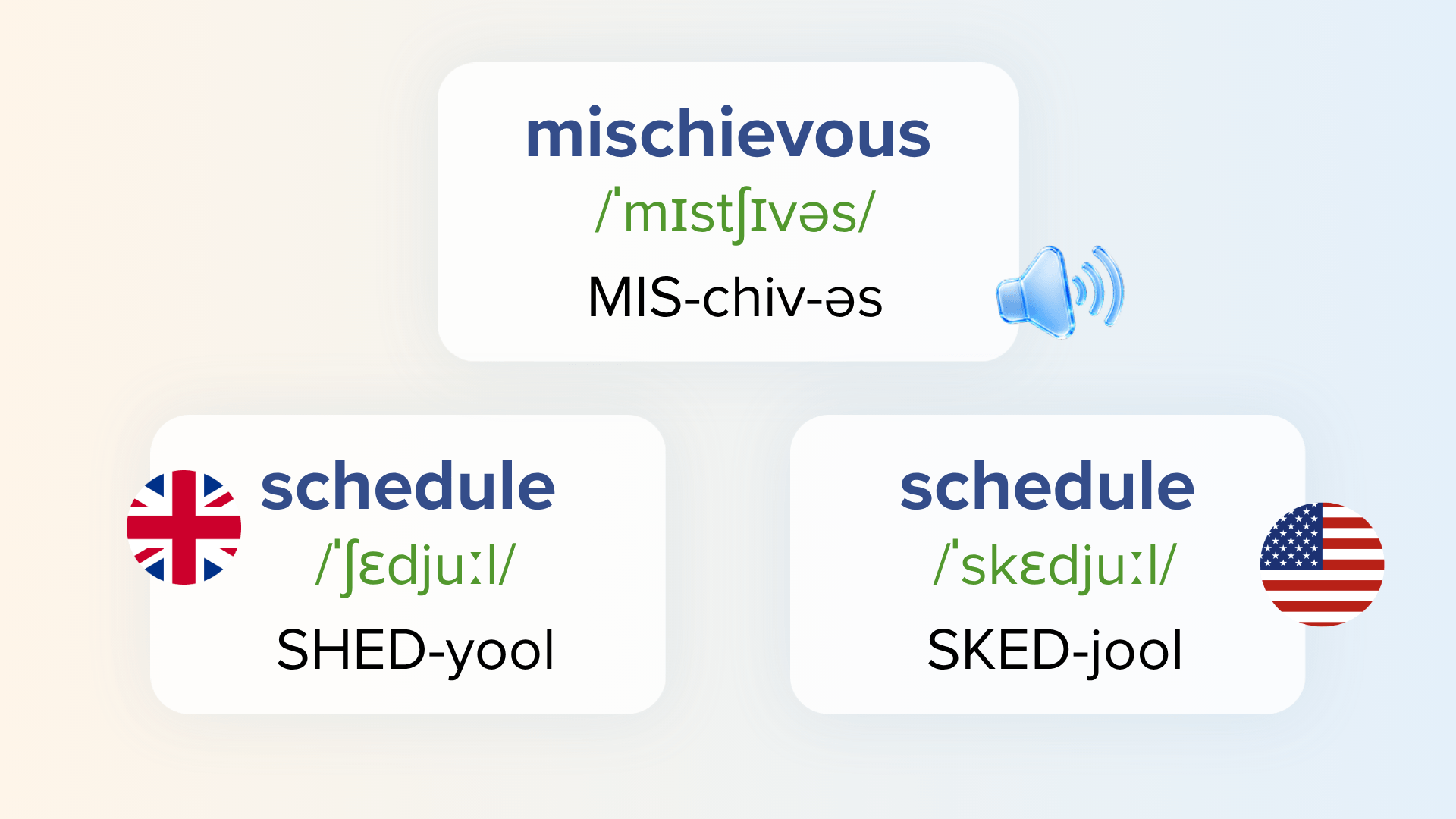
For example, schedule is often pronounced SHED-yool in British English and SKED-jool in American English. British speakers usually pronounce the H in herb, while American speakers commonly leave it silent.
When you encounter an unfamiliar word, avoid guessing its spelling. English spelling does not always reflect how a word sounds. Check the pronunciation in a trusted dictionary and, whenever possible, listen to an audio example.
How to hear a word pronounced in British and American English?
To hear how an English word is pronounced, look it up in Oxford Dictionary and play the British or American audio beside the entry. Listening alongside the phonetic spelling lets you compare regional pronunciations, such as schedule or privacy, and choose the version that matches the English you use.
Oxford Dictionary is free to download and has all 15 dictionaries, including the authoritative Oxford Dictionary of English for British English and the New Oxford American Dictionary for American English. Complete audio pronunciation coverage is available with Premium, letting you hear words spoken by native British and American speakers.
Frequently asked questions
Mischievous is pronounced MIS-chiv-əs, with three syllables and the stress on the first. It is often incorrectly pronounced with four syllables as “mis-CHEE-vee-us.” To check the pronunciation, you can look up the word in Oxford Dictionary and listen to it spoken by a native speaker.
The correct word is espresso. There is no X in its spelling or standard pronunciation. Expresso is a common error, but the word comes from the Italian espresso, meaning roughly “pressed out.”
British and American English developed separately over several centuries, so some words acquired different vowels, stress patterns, or consonant sounds. Schedule, privacy, vitamin, and herb are common examples. Neither regional pronunciation is inherently wrong, as each is standard within its variety of English.
Oxford Dictionary includes both British and American audio, allowing you to hear and compare accepted regional pronunciations.
In American English, the H in herb is usually silent, so the word sounds like “erb.” In British English, the H is pronounced. Both forms are standard, and the silent-H pronunciation is the older version retained in American English.
Choose the pronunciation that best matches your goals and audience. British pronunciation may be more useful when communicating primarily in the UK, while American pronunciation is generally more suitable for the US. Consistency matters more than treating one variety as universally correct.
Listening to the British and American recordings in Oxford Dictionary can help you compare the two and practise the variety you are learning.
Yes. Oxford Dictionary, built by MobiSystems, provides phonetic transcriptions alongside British and American audio recorded by native speakers. This allows you to check unfamiliar words, compare regional differences, and hear how each word is pronounced rather than relying on its spelling.
The bottom line
Most mispronunciations come from trusting the spelling – English rarely rewards that – or from not knowing a word has two correct forms. Learn the handful that trip everyone up, match British or American consistently, and when in doubt, hear the word rather than guess. A dictionary that gives you both accents, spoken by native speakers, settles it in seconds.